×
× 




Unit 9 Tiếng Anh lớp 8 về chủ đề Natural Disasters giúp các bạn học sinh nâng cao hiểu biết về các thảm họa thiên nhiên và những tác động của chúng đến cuộc sống con người. Bên cạnh việc mở rộng vốn từ vựng về thiên tai, các bài học còn giúp các bạn học sinh luyện tập và thực hành các kỹ năng Tiếng Anh về chủ đề này.
Trong bài viết dưới đây, IELTS LangGo sẽ cung cấp hướng dẫn chi tiết và đáp án đầy đủ cho các bài tập giúp các bạn học sinh nắm vững nội dung của Unit 9.
Phần Getting Started mở đầu với đoạn hội thoại We are all safe! giúp các bạn học sinh nắm được các từ vựng cơ bản về các thảm họa thiên nhiên và luyện kỹ năng đọc hiểu.
Đáp án:
1. There is a flood in Mi's home town.
2. Her uncle's family had to move everything to the second floor last night.
3. A tornado is an example of a violent storm.
4. Tom's family was having dinner when the tornado came.
5. The tornado damaged their roof and pulled up some trees in their yard.
Đáp án:
Hình (1) - Flood
Hình (2) - Tornado
Hình (3) - Volcanic eruption
Hình (4) - Storm
Hình (5) - Landslide
Hình (6) - Earthquake
1. When there is a(n) volcanic eruption, hot gases and liquid rock pour out from a mountain.
2. Oh, the house is shaking! I think we're having an earthquake.
3. We wanted to travel to Ha Giang, but there was a landslide. Some big rocks and mud came down the mountains.
4. Every year more than ten storms with strong winds and rain cause damage in our country.
5. A tornado looks like a huge funnel and causes a lot of damage. Its strong winds can reach 480 km per hour.
Work in groups. Complete the web with all of the words and phrases related to natural disasters you know.
Gợi ý các từ điền vào ô trống:
>> Xem lời giải chi tiết tại đây: Getting Started Unit 9 Tiếng Anh 8
Phần Từ vựng giúp các bạn học sinh mở rộng vốn từ liên quan đến thảm họa thiên nhiên và công tác cứu hộ.
Đáp án:
| A | B |
| 1. destroy | destruction |
| 2. erupt | eruption |
| 3. warn | warning |
| 4. predict | prediction |
| 5. damage | damage |
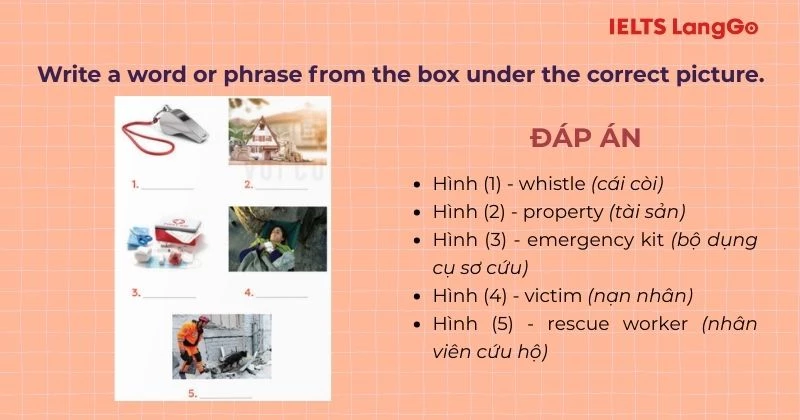
Đáp án:
Hình (1) - whistle
Hình (2) - property
Hình (3) - emergency kit
Hình (4) - victim
Hình (5) - rescue worker
Đáp án:
1. Natural disasters can cause serious damage to human life.
2. Local authorities gave a flood warning yesterday, so today people are moving to safer places.
3. To prepare for a natural disaster, we should make a(n) emergency kit.
4. It's hard to believe that we cannot predict when earthquakes will happen.
5. They lost all of their property because of the volcanic eruption.
Phần Pronunciation giúp các bạn học sinh luyện tập quy tắc đánh trọng âm đối với các từ kết thúc bằng đuôi -al và -ous.
Đáp án:
| /-al/ | /-ous/ |
| musical - /ˈmjuː.zɪ.kəl/ | dangerous - /ˈdeɪn.dʒər.əs |
| national - /ˈnæʃ.ən.əl/ | marvellous - /ˈmɑː.vəl.əs/ |
| personal - /ˈpɜː.sən.əl/ | humorous - /ˈhjuː.mə.rəs/ |
| practical - /ˈpræk.tɪ.kəl/ | humorous - /ˈhjuː.mə.rəs/ |
| practical - /ˈpræk.tɪ.kəl/ | poisonous - /ˈpɔɪ.zən.əs/ |
Đáp án:
1. The flood victims are collecting their personal property.
2. Avoid dangerous places, such as windows or bookcases, during an earthquake.
3. There are numerous tropical storms in this area every year.
4. Some natural disasters, such as landslides, usually happen in mountainous areas.
5. She gave us practical tips about treating poisonous wastes.
>> Xem lời giải chi tiết tại đây: A Closer Look 1 Unit 9 Tiếng Anh 8
Phần này giúp các bạn học sinh nắm được cách dùng và chia động từ thì Quá khứ tiếp diễn (The Past Continuous).
Đáp án:
1. They were helping the flood victims at 10 o'clock last night.
2. It wasn't snowing when I left home this afternoon.
3. While she was working in the field, the tornado came.
4. - What were you doing at 9 o'clock yesterday morning?
- I was watching the news about a volcanic eruption.
5. - Were you crying when I saw you two days ago? – No, I wasn't.
1. We donated / were donating money to help the earthquake victims last month.
→ Đáp án: donated
2. - What did you do / were you doing when the volcano erupted? - I slept / was sleeping in my bed.
→ Đáp án: were you doing - was sleeping
3. While they camped / were camping near the river, the flood was coming / came.
→ Đáp án: were camping - came
4. After Tom ran / was running out of his house, he moved / was moving quickly to a safer place.
→ Đáp án: ran - moved
5. I didn't read / wasn't reading a newspaper at 9 a.m. yesterday, but I watched / was watching the news about the tornado.
→ Đáp án: wasn't reading - was watching
Đáp án:
1. Lan's grandmother and grandfather were watching TV.
2. Lan's mother was reading a book.
3. Lan's father was drinking tea.
4. Lan's brother was drawing.
5. Lan was talking on the phone.
Đáp án:
1. you/ have dinner / 7 o'clock yesterday evening?
→ Were you having dinner at 7 o'clock yesterday evening?
→ Yes, I was. / No, I wasn't. I was taking a shower.
2. you/ do / homework / 8 o'clock / yesterday evening?
→ Were you doing your homework at 8 o'clock yesterday evening?
→ Yes, I was. / No, I wasn't. I was watching a movie.
3. you/watch / film /9 o'clock / yesterday evening?
→ Were you watching a film at 9 o'clock yesterday evening?
→ Yes, I was. / No, I wasn't. I was sleeping.
Work in groups. Take turns to say a sentence that describes what each person in the picture was doing.
Gợi ý trả lời:
1. Nam was throwing a paper plane.
2. Ha was talking to Nam.
3. Ann was talking to Ha.
4. Lan was singing.
5. Phong was sleeping on the desk.
6. Mi and Nick were talking.
7. Mai was reading a book.
>> Xem lời giải chi tiết tại đây: A Closer Look 2 Unit 9 Tiếng Anh 8
Phần Communication giúp các bạn học sinh tìm hiểu về mẫu câu thông báo tin xấu (Giving bad news) và cách đáp lại, chia sẻ sự cảm thông (Responding to bad news).
Mark: Phong, why are you so sad?
Phong: My grandparents called this morning. A flood destroyed their house.
Mark: I’m sorry to hear that.
Phong: It also damaged all of their crops.
Mark: That’s awful. I hope your grandparents are safe.
Tình huống 1: You have a friend in a mountainous area. A landslide destroyed his family’s garden yesterday. You share this news with your classmate.
Gợi ý hội thoại:
You: I just heard some bad news about Lan, our friend in Ha Giang.
Classmate: What happened?
You: A landslide destroyed her family's garden yesterday.
Classmate: Oh no! That's terrible. Is her family safe?
You: Yes, luckily, they are all safe.
Tình huống 2: You hear that a big earthquake hit a city. You share this news with your classmate.
Gợi ý hội thoại:
You: Did you read the news? A big earthquake hit Tokyo this morning.
Classmate: Really? I'm sorry to hear that. Did it cause much damage?
You: Yes, many buildings collapsed.
Classmate: That's awful. I hope the rescue workers can save the victims in time.
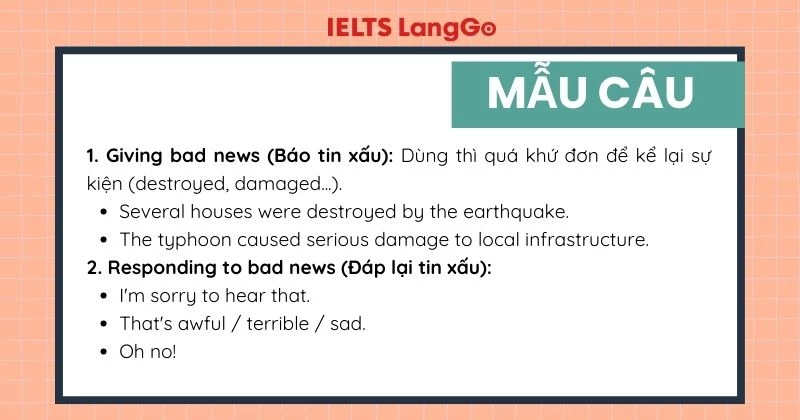
Gợi ý trả lời:
1. Nam: "We were travelling on the road near a mountain. Suddenly, a lot of rocks and mud came down the mountain."
→ Landslide
2. Ann: "While I was working in the garden, I saw a big funnel of wind moving towards us very quickly."
→ Tornado
3. Tom: "Suddenly, everything in our living room began to shake. My sister and I quickly hid under the table."
→ Earthquake
Đáp án:
Question 1: Which of these may cause landslides?
A. Heavy rain.
B. Wind.
C. Lightning.
→ Đáp án: A. Heavy rain.
Question 2: Which of these activities may cause landslides?
A. Littering.
B. Cutting down trees.
C. Polluting the air.
→ Đáp án: B. Cutting down trees.
Question 3: What scale is used for measuring earthquakes?
A. Fahrenheit scale.
B. Celsius scale.
C. Richter scale.
→ Đáp án: C. Richter scale.
Question 4: What natural disaster can an earthquake cause?
A. A flood.
B. A landslide.
C. A tornado.
→ Đáp án: B. landslide
Question 5: What do tornadoes form from?
A. An earthquake.
B. A flood.
C. A thunderstorm.
→ Đáp án: C. A thunderstorm.
Question 6: Where do tornadoes mostly happen?
A. In the USA.
B. In the UK.
C. In Viet Nam.
→ Đáp án: A. In the USA.
>> Xem lời giải chi tiết tại đây: Communication Unit 9 Tiếng Anh 8
Phần Skills 1 giúp học sinh rèn luyện 2 kỹ năng quan trọng: Reading (Đọc hiểu) qua bản tin về núi lửa và động đất và Speaking (Nói) thông qua hoạt động đưa bản tin về thảm họa thiên nhiên.
Đáp án:
1. 30 seconds of a slight shaking in Ha Noi → B. earthquake
2. A thick layer of ash covers Tonga → A. volcanic eruption
Đáp án:
1. d - violently: very strongly
2. e - tsunami: very large waves in the sea
3. a - missing: not yet found
4. b - trembling: slightly shaking
5. c - fear: the bad feeling you have when you are frightened
1. Where and when did the eruption happen?
→ It happened in the South Pacific (Tonga) last Saturday.
2. What did the eruption cause?
→ It caused a tsunami.
3. What were the other effects of the eruption?
→ It destroyed hundreds of homes on some small islands, and more than twenty people are missing.
4. How long did the buildings shake?
→ They shook for about 30 seconds.
5. What caused the shaking?
→ A strong earthquake in China caused it.
Đáp án:
1. What kind of natural disaster was it?
→ c. It was a serious flood.
2. When and where did it happen?
→ e. It happened in a village in Phu Yen last week.
3. What caused it?
→ a. Five days of heavy rain caused it.
4. What were its effects?
→ b. Many houses were flooded, two villagers died, and five others were missing.
5. How did people help the victims?
→ d. Rescue workers looked for the missing people, and volunteers gave food and drinks to the victims.
Gợi ý bài nói mẫu:
Good morning, everyone. Here is the news about a natural disaster in Phu Yen. Last week, a serious flood happened in a village in Phu Yen province. It was caused by five days of heavy rain. The flood had terrible effects. Many houses were flooded. Sadly, two villagers died, and five others went missing. Local authorities and people quickly took action. Rescue workers looked for the missing people immediately. Also, many volunteers gave food and drinks to the victims to help them overcome this difficult time. That's the end of the news. Stay safe!
>> Xem lời giải chi tiết tại đây: Skills 1 Unit 9 Tiếng Anh 8
Phần Skills 2 tập trung hai kỹ năng quan trọng là Listening (Nghe) qua bản tin về những việc cần làm trước, trong và sau cơn bão và Writing (Viết) qua bài tập viết đoạn văn hướng dẫn cách chuẩn bị và ứng phó với lũ lụt một cách an toàn.
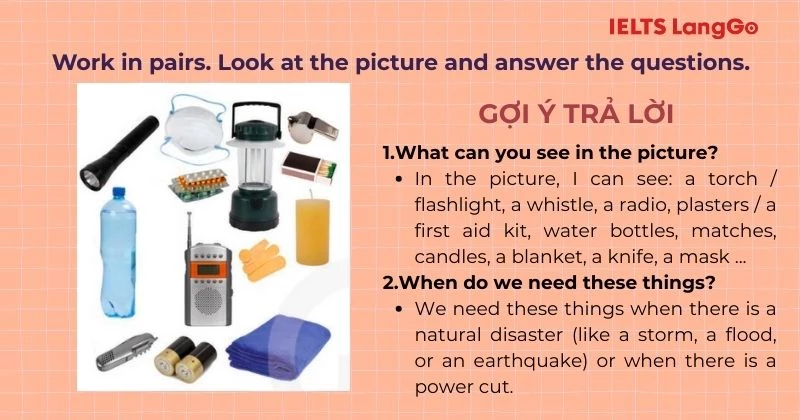
Gợi ý trả lời:
1. What can you see in the picture?
2. When do we need these things?
Đáp án:
| Before a storm | During a storm | After a storm |
| 2. Prepare an emergency kit | 3. Stay inside the house | 1. Listen to instructions from local authorities. |
| 6. Strengthen houses | 5. Avoid windows and glass doors | 4. Keep away from dangerous areas |
Đáp án:
1. F - The broadcast is on TV.
2. T - You should bring flowerpots and rubbish bins into the house.
3. F - Right after the storm, you can leave your home.
4. T - The local authority may warn you about dangerous places.
Gợi ý trả lời:
| Before a flood | During a flood | After a flood |
| - Prepare an emergency kit | - Stay inside a safe and high place | - Avoid moving water |
| - Move furniture to higher floors | - Turn off the electricity | - Listen to the news |
| - Store food and fresh water | - Don't swim or walk through flood water | - Clean up the house |
| - Block the doors | - Keep away from power lines | - Don't drink tap water without boiling |
Bài viết mẫu:
Here are the things you should do before, during, and after a flood to stay safe.
Before a flood, it is important to prepare an emergency kit with food, water, and medicine. You should also move your furniture and valuable things to the higher floors of your house to avoid water damage.
During a flood, make sure to turn off the electricity and gas. Stay inside a safe and high place. Do not swim or walk through moving water because it is very dangerous.
After a flood, keep listening to the local news for instructions. Only return home when it is safe. Clean up your house carefully and do not drink tap water until the authorities say it is clean.
>> Xem lời giải chi tiết tại đây: Skills 2 Unit 9 Tiếng Anh 8
Phần Looking back Unit 9 lớp 8 giúp học sinh ôn tập 2 nội dung kiến thức quan trọng: Vocabulary (Từ vựng) về các thảm họa thiên nhiên và Grammar (Ngữ pháp) về Thì quá khứ tiếp diễn (Past Continuous).
Đáp án:
What natural disaster involves
1. a lot of water in an area? → Flood
2. heavy rain and strong winds? → Storm / Typhoon
3. the earth trembling? → Earthquake
4. ash and gas? → Volcanic eruption
5. rocks and mud coming down hills or mountains? → Landslide
Đáp án:
1. The tsunami brought destruction to cities and towns near the sea. (destroy)
2. The government has developed some systems to help make predictions about natural disasters. (predict)
3. We are donating money and food to help the victims of the landslide. (victim)
4. The local authorities warned the villagers about a landslide yesterday. (warn)
5. Rescue workers are trying hard to save people in the flooded area. (work)
Đáp án:
1. What were you doing at 8 o'clock yesterday morning?
2. Last year, earthquakes destroyed a lot of houses in Japan.
3. He was watering the flowers in his garden when the tornado came.
4. While they were calling for help, the rescue workers appeared.
5. Were you listening to music at 9 o'clock yesterday evening?
At 7 p.m. yesterday,...
Gợi ý trả lời:
1. I was doing my homework.
2. My grandmother was watching TV.
3. My mother was cooking dinner.
4. My father was reading a newspaper.
5. My sister was listening to music.
>> Xem lời giải chi tiết tại đây: Looking Back Unit 9 Tiếng Anh 8
Phần này về chủ đề Natural Disasters - What do you know about it? là một dự án học tập thú vị giúp các bạn học sinh nâng cao hiểu biết về thiên tai và các biện pháp phòng tránh, ứng phó trong những tình huống khẩn cấp.
Một số thảm họa thiên nhiên mà bạn có thể tham khảo:
Lựa chọn 1: Earthquakes
Dưới đây là bảng thông tin về thảm họa Động đất (Earthquakes):
| Câu hỏi | Nội dung |
| What causes it? | The movement of the Earth's plates (crust). |
| Where and when does it usually happen? | Along the "Ring of Fire" (Pacific Ocean), it can happen anytime without warning. |
| What effects can it have? | Collapse of buildings/bridges, landslides, tsunamis, loss of life. |
| What should people do before, during, and after it happens?
| - Before: Prepare an emergency kit, fasten heavy furniture. - During: Drop, Cover, and Hold on (Hide under a strong table). Stay away from windows. - After: Check for injuries, stay away from damaged buildings. |
Bài mẫu thuyết trình về Earthquakes
Hello teacher and everyone. Today, our group would like to present our poster about earthquakes. As you can see, an earthquake is the sudden shaking of the Earth's surface. So, what causes it? It is mainly caused by the movement of tectonic plates deep underground.
Where does it happen? Earthquakes often happen along the 'Ring of Fire' in the Pacific Ocean. Unlike storms, they can happen anytime without warning. About the effects, earthquakes are very dangerous. They can destroy buildings, bridges and lead to landslides or tsunamis.
Most importantly, what should we do?
That brings us to the end of our presentation. Thank you for listening!
>> Xem lời giải chi tiết tại đây: Project Unit 9 Tiếng Anh 8
Tiếng Anh lớp 8 Unit 9 về chủ đề Natural Disasters đã giúp học sinh hiểu rõ hơn về các thảm họa thiên nhiên, đồng thời học cá từ vựng và luyện Nghe - Nói - Đọc - Viết xoay quanh chủ đề này.
Hy vọng rằng với đáp án chi tiết và gợi ý trả lời từ IELTS LangGo, các bạn học sinh sẽ nắm vững nội dung bài học, cải thiện các kỹ năng và tự tin hơn khi gặp các dạng bài tương tự.










ĐẶT LỊCH TƯ VẤN MIỄN PHÍ LỘ TRÌNH Săn ƯU ĐÃI lên tới 12.000.000đ